
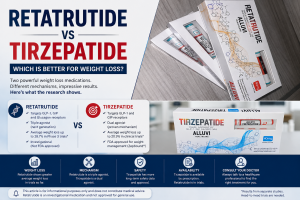
Retatrutide vs Tirzepatide: Which Is Better for Weight Loss?
Retatrutide and tirzepatide are two of the most closely watched medications in modern obesity research. Both target multiple hormone pathways involved in appetite, metabolism, and body weight, but they are not the same medication.
Tirzepatide is already an approved treatment for obesity and overweight in appropriate adults, while retatrutide remains an investigational medicine undergoing clinical development.
So, how does retatrutide compare with tirzepatide, and which one appears more effective for weight loss?
The answer requires an important distinction: there is currently no definitive head to head clinical trial proving that retatrutide is superior to tirzepatide. The available weight loss percentages come from separate clinical trials involving different populations and study designs.
What Is Retatrutide?
Retatrutide, also known as LY3437943, is an investigational once weekly triple hormone receptor agonist developed by Eli Lilly.
It activates three receptors:
This triple mechanism distinguishes retatrutide from currently available dual agonists. Researchers are investigating whether activating the glucagon receptor in addition to GLP 1 and GIP can produce greater effects on body weight and metabolic health.
Retatrutide peptide is currently in Phase 3 clinical development and has not been approved by the FDA or another regulatory agency. Lilly has stated that it plans to submit a Biologics License Application to the FDA in 2027.
What Is Tirzepatide?
Tirzepatide is a dual GIP and GLP 1 receptor agonist. It is marketed as Zepbound for chronic weight management and as Mounjaro for type 2 diabetes.
The FDA approved Zepbound for chronic weight management in adults with obesity or overweight accompanied by at least one weight related condition, alongside a reduced calorie diet and increased physical activity.
Unlike retatrutide, tirzepatide peptide has an established regulatory approval and a substantial body of clinical evidence supporting its use.
Retatrutide vs Tirzepatide: The Main Difference
The biggest difference is their mechanism of action.
| Feature | Retatrutide | Tirzepatide |
|---|---|---|
| GLP 1 receptor | Yes | Yes |
| GIP receptor | Yes | Yes |
| Glucagon receptor | Yes | No |
| Current regulatory status | Investigational | Approved |
| Weight loss research | Very promising | Established |
| Long term safety data | Still developing | More extensive |
| Clinical availability | Clinical trials | Available by prescription |
Retatrutide therefore takes a broader hormonal approach, while tirzepatide has two established targets.
Which Produces More Weight Loss?
This is where comparisons become particularly interesting.
In the Phase 2 retatrutide obesity trial, participants receiving the highest studied dose experienced an average weight reduction of 24.2% after 48 weeks. Gastrointestinal adverse events were the most common side effects, and researchers also observed dose dependent increases in heart rate.
More recent Phase 3 results have been even more striking. In TRIUMPH 4, participants receiving 12 mg of retatrutide experienced an average 28.7% reduction in body weight at 68 weeks, while the placebo group experienced a 2.1% reduction.
Tirzepatide has also demonstrated substantial weight loss. In the SURMOUNT 1 program, tirzepatide produced significant and sustained weight reduction over 72 weeks, and a later head to head study found tirzepatide superior to semaglutide for weight reduction.
However, you should not interpret the 28.7% retatrutide result as proof that retatrutide is better than tirzepatide. These results came from different studies, with different participants, treatment durations, doses, and trial designs.
A properly designed head to head randomized trial would be needed to establish superiority.
Retatrutide vs Tirzepatide for Appetite Control
Both medications can reduce appetite and food intake through GLP 1 and GIP activity.
Retatrutide adds glucagon receptor activation, which researchers believe may contribute to additional effects on energy expenditure and metabolism. This may partly explain the substantial weight reductions observed in clinical trials.
Tirzepatide, meanwhile, already produces powerful appetite and weight effects through its dual GIP and GLP 1 activity.
Therefore, both medications have demonstrated meaningful effects on appetite and body weight, but the long term clinical significance of retatrutide’s additional glucagon activity is still being evaluated.
Side Effects: Retatrutide vs Tirzepatide
The side effect profiles overlap considerably.
Common gastrointestinal effects associated with these types of medications include:
- Nausea
- Vomiting
- Diarrhea
- Constipation
- Abdominal discomfort
- Reduced appetite
In the Phase 2 retatrutide study, gastrointestinal adverse events were the most common and were generally mild to moderate.
Tirzepatide also has gastrointestinal warnings and precautions in its prescribing information. Its FDA approved labeling includes important warnings, including a boxed warning concerning thyroid C cell tumors observed in rats and a contraindication for people with a personal or family history of medullary thyroid carcinoma or Multiple Endocrine Neoplasia syndrome type 2.
Because retatrutide remains investigational, its complete long term safety profile cannot yet be compared directly with that of an approved medication such as tirzepatide.
Which Is Safer?
Tirzepatide currently has the stronger safety record for clinical use because it has been studied extensively and has regulatory approval.
Retatrutide has produced encouraging safety results in clinical trials, but it is still undergoing development. Phase 3 trials are designed to provide much more information about its safety and effectiveness across larger populations and longer periods.
This distinction matters. A medication can produce impressive results in clinical trials without yet having enough evidence to establish its long term safety for widespread use.
Is Retatrutide Better Than Tirzepatide?
There is no scientifically responsible way to give a definitive yes or no at this stage.
Retatrutide has demonstrated exceptionally strong weight loss results in clinical trials and could potentially become an important future treatment for obesity. Recent Phase 3 results have strengthened that possibility.
Tirzepatide, however, has an important advantage today: it is an approved treatment with established clinical use and regulatory oversight.
Retatrutide’s potential advantage is its triple receptor mechanism and the magnitude of weight loss observed in clinical research.
Can You Take Retatrutide and Tirzepatide Together?
They should not be combined unless specifically directed within an appropriate clinical research protocol.
Both medications influence overlapping metabolic pathways, and there is no established clinical basis for consumers to combine them independently. Tirzepatide’s FDA labeling specifically states that coadministration with other tirzepatide containing products or GLP 1 receptor agonists is not recommended.
Anyone considering switching between these medications should discuss the transition with a qualified healthcare professional.
Which One Should You Choose?
For someone seeking an approved prescription treatment today, tirzepatide has a clear advantage because it has already undergone regulatory review and is available for appropriate patients.
Retatrutide is different. It is a promising investigational medicine whose clinical results have generated considerable interest, but it is not currently approved for routine treatment.
Lilly explicitly states that retatrutide is legally available only to participants in its clinical trials and warns against products sold outside those trials because their identity, purity, strength, and safety cannot be verified.
Final Verdict
Retatrutide vs tirzepatide is not simply a matter of choosing the medication with the biggest percentage on a clinical trial chart.
Retatrutide is a triple agonist targeting GLP 1, GIP, and glucagon and has demonstrated exceptionally large weight reductions in clinical trials. Tirzepatide is a dual GIP and GLP 1 agonist with extensive clinical evidence and regulatory approval for appropriate weight management patients.
Based on current evidence, retatrutide appears highly promising and may eventually become one of the most effective pharmacological treatments for obesity. But it cannot yet be declared superior to tirzepatide because there is no definitive head to head evidence establishing that conclusion.
For people considering treatment today, the more appropriate question is not simply which drug produces the largest number in a study. It is which approved treatment is appropriate for their medical history, health goals, risks, and individual response under professional medical supervision.
Medical disclaimer: This article is for educational purposes only and does not constitute medical advice. Retatrutide is an investigational medicine and should not be used outside an authorized clinical trial. Talk with a qualified healthcare professional before starting, stopping, or changing any prescription medication.