
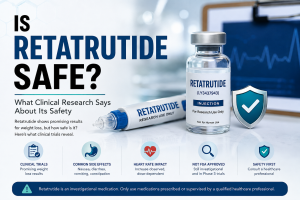
Is Retatrutide Safe? What Clinical Research Says About Its Safety
Retatrutide has attracted significant attention as a potential next generation treatment for obesity and metabolic disease. Clinical trials have demonstrated substantial weight loss, but an important question remains: is retatrutide safe?
The short answer is that retatrutide has shown a generally manageable safety profile in clinical trials, but its long term safety is still being evaluated. More importantly, retatrutide remains an investigational medicine and is not currently approved for routine public use.
What Is Retatrutide?
Retatrutide, also known as LY3437943, is an investigational medication developed by Eli Lilly. Unlike medications that target one or two metabolic hormone pathways, retatrutide activates three receptors: GLP 1, GIP, and glucagon.
This triple mechanism is one reason researchers are investigating its potential for significant weight reduction and improvements in metabolic health. In clinical studies, retatrutide has produced substantial reductions in body weight.
Is Retatrutide Safe?
Based on available clinical trial evidence, retatrutide appears to have a safety profile that is broadly consistent with other medications affecting gastrointestinal and metabolic hormone pathways. However, calling it completely safe would be misleading.
In a Phase 2 trial involving 338 adults, the most frequently reported adverse effects were gastrointestinal problems such as nausea, diarrhea, vomiting, constipation, and reduced appetite. These effects were generally mild to moderate and occurred particularly during dose escalation.
The same study found that adverse events became more common at higher doses. Treatment discontinuation because of adverse events occurred in approximately 6% to 16% of participants receiving retatrutide, depending on the treatment group.
What Are the Common Side Effects?
The most commonly reported side effects associated with retatrutide include:
- Nausea
- Diarrhea
- Vomiting
- Constipation
- Reduced appetite
- Abdominal or digestive discomfort
These effects appear to be particularly associated with dose escalation. The Phase 2 study found that using a lower starting dose helped reduce gastrointestinal adverse events.
Does Retatrutide Affect Heart Rate?
Yes. Increased heart rate has been observed during retatrutide treatment.
In the Phase 2 study, heart rate increased in a dose dependent manner, reaching its highest point around 24 weeks before subsequently declining. This is one reason cardiovascular effects remain an important area of continued research.
Phase 3 research has also continued to monitor cardiovascular and other safety outcomes as researchers evaluate retatrutide in larger populations.
What About Serious Side Effects?
Serious adverse events have occurred in clinical trials, although they were not necessarily caused by retatrutide.
In the Phase 2 study, serious adverse events occurred in about 4% of both the retatrutide and placebo groups. One participant receiving retatrutide developed acute pancreatitis, while the single death reported in the study was attributed by the investigator to drowning rather than retatrutide.
These findings do not establish that retatrutide is free from serious risks. Instead, they demonstrate why larger and longer clinical trials are necessary before its overall safety profile can be fully established.
Is Retatrutide FDA Approved?
No.
As of September 2026, retatrutide remains an investigational medicine and has not been approved for routine public use. Eli Lilly states that retatrutide is currently being studied in Phase 3 clinical trials and is available only to participants in authorized clinical research.
The FDA has also specifically warned that retatrutide is not an approved component of FDA approved medicines and cannot legally be used in compounding under federal law.
Therefore, products sold online as “research retatrutide,” “retatrutide peptide,” or unauthorized retatrutide injections should not be assumed to have the same quality, purity, identity, or safety as the material administered in controlled clinical trials.
What About Retatrutide Purchased Online?
This is an important distinction.
Clinical trial results apply to investigational retatrutide manufactured and administered under controlled research conditions. They do not automatically apply to products purchased from unverified websites or unauthorized suppliers.
Eli Lilly warns that unauthorized products claiming to contain retatrutide could contain incorrect amounts of active ingredient, contaminants, impurities, or even a completely different substance.
The FDA has similarly expressed concerns about unapproved products marketed as retatrutide.
Consequently, the safety of an online product cannot be established simply because clinical trials have reported encouraging results for pharmaceutical retatrutide.
What Have Clinical Trials Found So Far?
The evidence is encouraging but incomplete.
In the 2023 Phase 2 trial, participants receiving higher doses achieved considerably greater weight loss than those receiving placebo. At 48 weeks, average weight reduction reached approximately 24.2% in the 12 mg group compared with 2.1% with placebo.
More recent Phase 3 research has also produced substantial weight loss results. In the TRIUMPH 1 study, participants receiving 12 mg retatrutide experienced an average weight reduction of 28.3% at 80 weeks.
However, effectiveness does not automatically mean that a medication is appropriate or safe for everyone.
So, Should You Take Retatrutide?
Until retatrutide receives regulatory approval and its longer term safety profile is better established, it should not be treated like an ordinary approved weight loss medication.
People considering retatrutide should discuss their situation with a qualified healthcare professional rather than relying on online dosing recommendations or products from unverified sources.
Final Takeaway
Is retatrutide safe?
Current clinical evidence suggests that retatrutide can be tolerated by many participants under controlled clinical trial conditions, with gastrointestinal side effects being particularly common. However, it can also cause adverse events, and important questions about its longer term safety remain under investigation.
Most importantly, retatrutide is still investigational and is not currently approved for routine public use. Therefore, it would be inaccurate to describe retatrutide as completely safe or to assume that products sold outside legitimate clinical trials carry the same safety profile as the medication studied in clinical research.
This article is for educational purposes and should not replace advice from a qualified healthcare professional.